
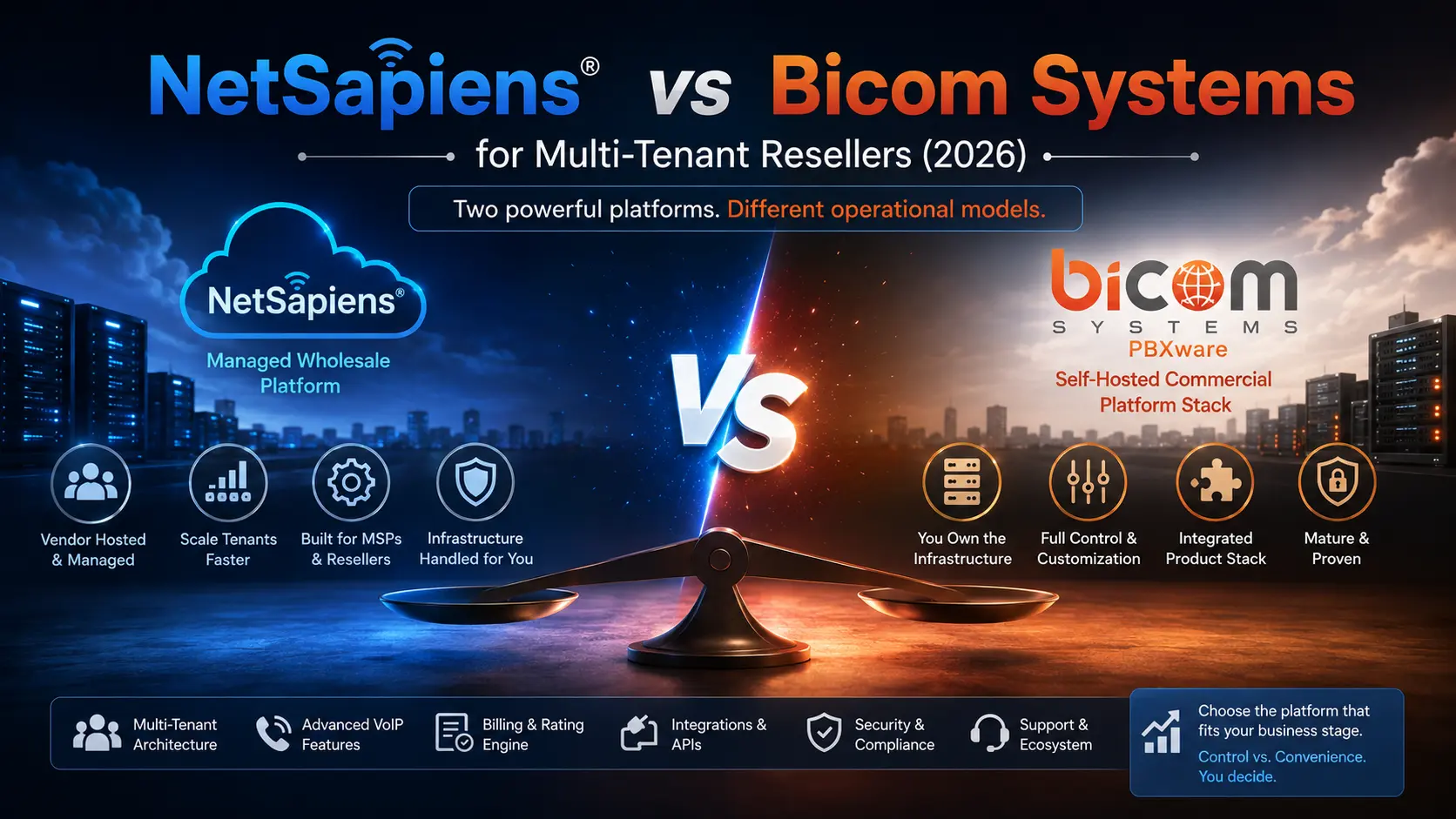
If you operate a VoIP reseller business on Bicom Systems’ PBXware and you’re evaluating NetSapiens®, you’re asking a different question than the FreePBX → NetSapiens® migration question. Bicom is already a serious multi-tenant platform. The decision is about operational model — who runs the infrastructure, who absorbs the engineering work, what level of platform control you retain — not about leaving an undersized platform behind.
This guide is the honest side-by-side. If you’re earlier in that journey and still on FreePBX or a legacy on-prem PBX, the NetSapiens® vs FreePBX migration guide is the companion piece.
When this question matters
The Bicom vs NetSapiens® conversation usually happens for one of three reasons:
- Infrastructure operational burden has grown. Your team is spending more time on server patching, backups, and platform monitoring than on customer-facing engineering. The math shifts when the platform-running cost (in engineering hours) exceeds the cost of moving to a vendor-hosted alternative.
- A customer-facing requirement is hard to deliver on Bicom. Specific feature additions, regional expansion, integration with a vendor ecosystem that’s stronger on the other platform.
- A strategic shift in the business. You’re being acquired, you’re acquiring, you’re consolidating multiple platforms into one, or you’re spinning off a division onto a different platform.
None of these mean Bicom is wrong. They mean the trade between platform control and operational burden has shifted in your situation.
The direct answer
Stay on Bicom Systems when:
- Your team has deep platform-engineering expertise and capacity
- Infrastructure operational burden is well within your engineering team’s scope
- You need fine-grained control over the platform layer for technical or commercial reasons
- Your customer pipeline doesn’t require platform features Bicom doesn’t deliver
Consider migrating to NetSapiens® when:
- Engineering hours on platform infrastructure (servers, backups, patching) are squeezing customer-facing engineering capacity
- You’re scaling tenant count fast and the per-tenant operational cost on Bicom is becoming a bottleneck
- You want a more vendor-managed wholesale model so your team can focus on tenants rather than infrastructure
It’s a judgement call, not a clear-cut decision. Both platforms have happy reseller customers.
Side-by-side comparison
| Dimension | Bicom Systems (PBXware) | NetSapiens® |
|---|---|---|
| Operational model | Self-hosted commercial platform stack | Vendor-hosted wholesale UCaaS platform |
| Infrastructure | You run servers, backups, monitoring, security patching | Crexendo runs the platform; you operate inside tenants |
| Multi-tenant native | Yes, designed for multi-tenant resellers | Yes, designed for multi-tenant resellers |
| Underlying technology | Asterisk-based commercial stack | Purpose-built commercial UCaaS platform |
| Tenant customization | Per-tenant dial plans, IVR, features | Per-tenant dial plans, IVR, features |
| Billing platform | telcoBilling (Bicom's billing module) | Bill Center (NetSapiens® billing module) |
| BYOC support | Yes | Yes |
| 10DLC (US SMS) | Integration / build your own | Native TCR integration |
| Platform control | High — you own the deployment | Moderate — vendor controls the underlying platform |
| Operational complexity for the reseller | Higher — you carry infrastructure ops | Lower — vendor carries infrastructure ops |
| Best fit | Resellers with strong in-house engineering and a preference for control | Resellers wanting to focus engineering on tenants, not infrastructure |
Where Bicom Systems is genuinely strong
Bicom isn’t a fallback or a stepping-stone. It’s a serious platform with real strengths:
- Self-hosted control. You own the deployment. Configuration, customization, and platform-level changes are entirely within your team’s authority. For resellers with specific technical requirements, this matters.
- Mature multi-tenant architecture. PBXware was designed for the reseller use case from the start. Tenant isolation, per-tenant customization, and operational tooling are not bolted on.
- Integrated platform stack. Bicom sells the surrounding products (telcoBilling, sipPROT for SIP security, gloCOM softphone) as part of a coordinated stack. For resellers who value buying from one vendor, this is simpler than assembling NetSapiens® + third-party billing + third-party security.
- Strong reseller program. Bicom’s commercial reseller program is well-established and predictable.
For a reseller with the engineering team to operate the stack and the preference for platform-level control, Bicom is genuinely fine.
Where Bicom becomes the operational ceiling
The friction we see when resellers outgrow what their team can comfortably operate on Bicom:
- Infrastructure operational burden scales with deployment size. Servers, backups, monitoring, security patching, capacity planning — all grow with tenant count and call volume. At some scale, the operational team needed becomes a meaningful headcount line.
- Platform-version upgrades are real projects. Each Bicom version upgrade is a coordinated maintenance window across your deployment, with regression-risk for tenant configurations. Cumulative version drift between deployments adds operational tax.
- Vendor ecosystem integrations are more DIY. PSA integrations, CRM dial-out connectors, recording archive integrations — Bicom has options, but more of the integration work is on the reseller’s engineering team than on a vendor-hosted platform.
- Geographic expansion needs more infrastructure. Standing up a new region typically means standing up new infrastructure. NetSapiens®, as a vendor-hosted platform, presents this as a tenant configuration rather than an infrastructure project.
- Compliance and security obligations. Self-hosted means you own the security posture, the patching schedule, the audit evidence. Vendor-hosted means much of that responsibility shifts to the vendor.
None of these are dealbreakers individually. Cumulatively, they’re what shifts a reseller’s calculus.
What NetSapiens® delivers that matters most
For a reseller specifically — not a single-business operator — the operational shift onto NetSapiens® has these practical effects:
- Infrastructure operations move to Crexendo. Server uptime, backup, patching, and capacity planning are the vendor’s responsibility, not yours.
- New-tenant provisioning is a workflow. Clone from template, override customizations, attach products, live. The provisioning guide walks through the structure.
- Vendor-managed integrations. 10DLC TCR integration, vendor-supported phone provisioning workflows, documented APIs for tenant automation.
- Geographic expansion is a tenant decision, not an infrastructure decision. Adding tenants in new regions doesn’t require new servers.
The trade is licensing cost and a different model of platform control. For some resellers, the trade is clearly worth it; for others, it isn’t.
Migration considerations (Bicom → NetSapiens® specifically)
If you decide to migrate, the structure is broadly similar to any reseller migration to NetSapiens® — discovery, tenant build, parallel testing, porting, wave-based cutover, stabilisation. The 6-phase migration playbook covers the full structure.
A few Bicom-specific notes that differ from a FreePBX migration:
- Bicom dial plans translate more cleanly. Both platforms are concept-aligned (match rules, translations, routes). The translation is still engineering judgement, but it’s more conceptual mapping than from-scratch replication.
- Integrated billing migration is its own project. Moving from telcoBilling to NetSapiens® Bill Center requires re-creating rate plans, product catalogs, and integration mappings. Plan for it as a parallel workstream.
- Phone re-provisioning is largely the same. IP phones (Yealink, Poly, Cisco) auto-provision against the new platform via the same mechanisms used on Bicom (DHCP option 66, vendor redirection).
- gloCOM softphone users need to move to the NetSapiens® native apps. Plan the softphone transition as a customer-communication exercise, not just a technical migration.
Decision framework — three questions
If you answer “yes” to all three, migration is worth scoping:
- Has infrastructure operational work started squeezing customer-facing engineering capacity?
- Is your customer pipeline likely to keep growing tenant count over the next 12-18 months?
- Is the operational model (vendor-hosted vs self-hosted) a constraint you’d rather not carry?
If you answered “no” to any, Bicom is probably still the right call. Revisit in 6 to 12 months.
What we run for resellers
We work with resellers on both platforms, and we’ve helped customers migrate in both directions when the business case warranted it. Our VoIP migrations service handles the Bicom → NetSapiens® path specifically, with rollback paths and documented per-tenant cutovers. For ongoing operational support on either side, the NetSapiens® support and operations page covers our platform-specific work in detail.
Independence and disclosure
VoIP Support Pro is an independent provider of support and migration services for the NetSapiens® platform. We are not affiliated with, endorsed by, or sponsored by NetSapiens® or Crexendo, Inc., nor by Bicom Systems. NetSapiens® is a registered trademark of Crexendo, Inc. PBXware and telcoBilling are products of Bicom Systems. We have no commercial stake in pushing any reseller off Bicom — our commercial interest is in matching the right operational tool to the right business stage. Use this guide as one input among several to your decision.