
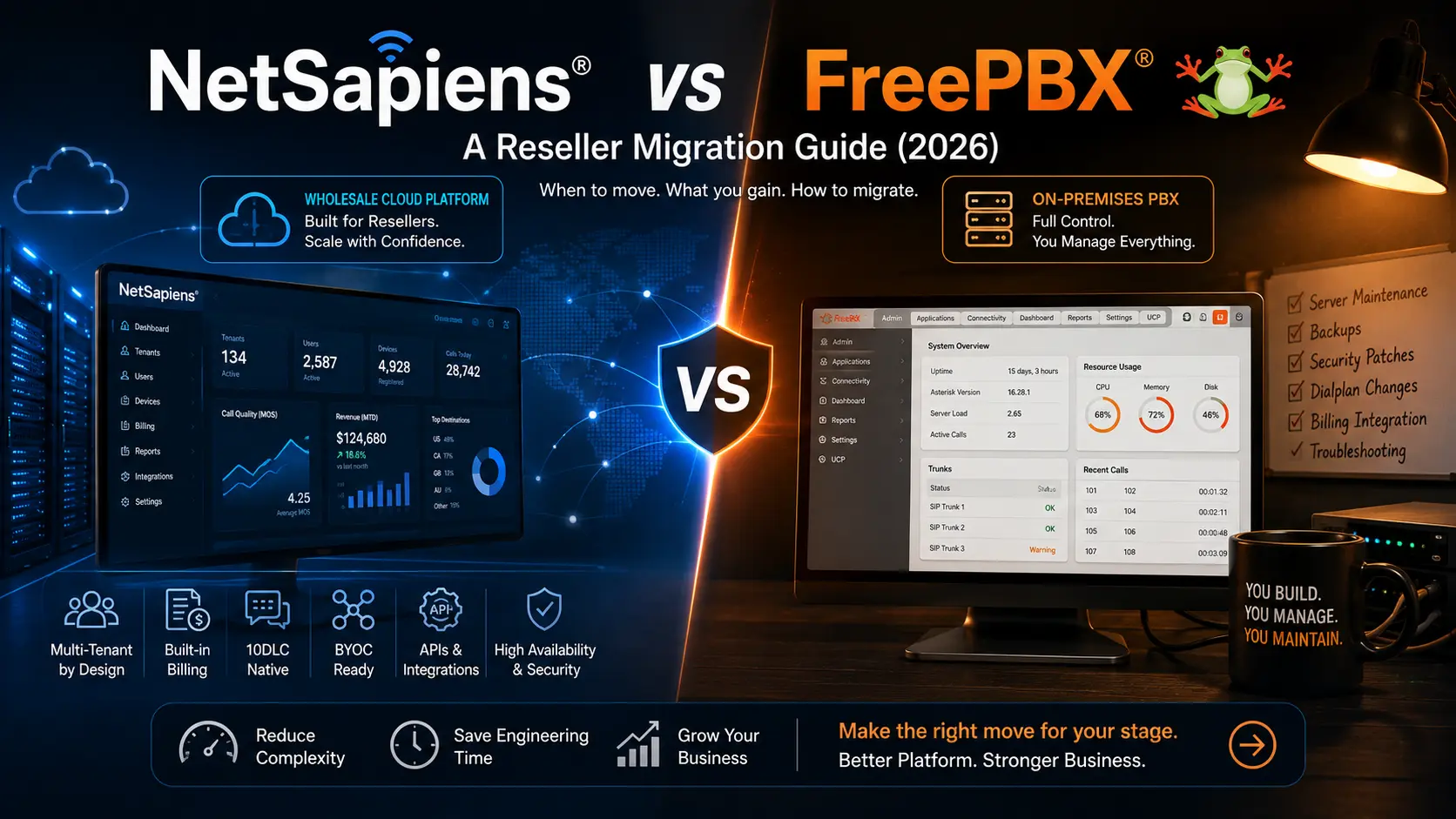
If you operate a VoIP reseller business on FreePBX and you’re asking whether NetSapiens® is worth migrating to, you’re probably 18-24 months in and noticing that the engineering hours per customer have started rising faster than your revenue per customer. That’s the actual signal. This guide walks through when the trade is worth making, when FreePBX is still the right call, and what the migration itself looks like.
When this question actually matters
You don’t ask “NetSapiens® vs FreePBX” on day one. You start on FreePBX because it’s free, the community is large, and a single Asterisk install handles your first one or two customers fine. The question shows up later, when one of three things has happened:
- You’ve added enough tenants that maintenance is eating engineering time. Patching servers, backing up configurations, debugging tenant-to-tenant interactions, and onboarding new customers all scale linearly — and at some tenant count, the math stops working.
- A customer asks for something you can’t deliver without rebuilding the stack. Branded portals, billing tier separation, 10DLC SMS, multi-region failover, BYOC carrier flexibility — these are pieces FreePBX doesn’t ship with. Adding them is doable but expensive.
- A compliance opportunity needs multi-tenant isolation guarantees. HIPAA-aware deployments, PCI-aware call recording, audit trails per tenant — FreePBX assumes a single trusted operator, and proving multi-tenant isolation for audit is real work.
If you’re in one of those three places, the migration conversation is real. If you’re not, FreePBX is probably still fine.
The direct answer
Migrate to NetSapiens® when ALL of these are true:
- You have 5 or more active tenants and the customer pipeline is healthy
- Engineering hours per ticket are trending up, not down
- You want to commercialise features (branded portal, billing tiers, SMS/10DLC, BYOC) that FreePBX requires rebuilding the stack to deliver
Stay on FreePBX when:
- You operate one to three customer deployments
- Engineering capacity for the operational burden is genuinely fine
- Your customers aren’t asking for anything FreePBX can’t deliver
That’s the short version. Below is the detail.
Side-by-side comparison
| Dimension | FreePBX | NetSapiens® |
|---|---|---|
| License cost | Free (open-source GPL) | Paid wholesale, per-tenant or per-seat licensing through Crexendo |
| Multi-tenant native | No (single-tenant by design; you build the multi-tenant layer) | Yes (each customer is a separate domain, isolated by default) |
| Operational maintenance | You patch, back up, monitor, and secure the servers | Crexendo runs the platform; you operate inside tenants |
| Built-in billing | None; integrate or build your own rating engine | Built-in bill center; integrates with Rev.io, QuickBooks, and similar |
| BYOC (Bring Your Own Carrier) | Yes, but you wire up the trunks per server | Yes, with tenant-level SIP trunk assignment |
| 10DLC native (TCR integration) | Build your own integration | Yes, native |
| APIs / automation | Asterisk Manager Interface (AMI) + community modules | REST and SOAP, documented for SP automation workflows |
| Per-tenant customization | Per server / per-installation; you stand up new instances | Per-tenant inside one platform; clone-from-template workflow |
| Community vs vendor support | Large open-source community; commercial support optional | Vendor-supported wholesale platform with operator community |
| Best operational fit | 1-3 deployments, hobbyist or niche operators, full engineering control | 5+ tenants, growing reseller, branded UCaaS, multi-region or compliance needs |
Where FreePBX is genuinely fine
There’s no rule that says FreePBX is wrong. It’s a serious piece of software with a serious community. Where it works well:
- Single-customer deployments — a hospital, a campus, a single mid-sized business that wants its own PBX. FreePBX is competitive with most commercial PBX products at that scale.
- Operators with deep Asterisk experience. If your team can read dialplan code, troubleshoot SIP traces, and patch their own servers, FreePBX is genuinely powerful and the cost advantage is real.
- Hobbyist or low-volume resellers. If you have one to three tenants and the operational work fits in a few hours a week, the math favours staying.
The point isn’t that FreePBX is bad. The point is that the cost of running FreePBX as a multi-tenant business scales with tenant count, while the cost of running NetSapiens® scales with usage.
Where FreePBX breaks down for resellers
The friction we see most often once a reseller crosses ~5 active tenants:
- Multi-tenant configuration drift. Each tenant ends up with its own copy of dial-plan logic, often in a separate installation. Keeping changes consistent across tenants becomes a manual audit.
- Patch management at scale. Asterisk and the underlying OS need ongoing security patches. Doing this safely across 5+ production servers, without breaking customer-specific tweaks, becomes a real ops job.
- Billing as a side project. Most FreePBX resellers integrate a third-party billing tool. Reconciling CDRs against rate plans, handling prorated billing, disputes, and rate updates is a recurring tax on engineering time.
- 10DLC and SMS. TCR registration, brand vetting, and campaign management aren’t FreePBX features. You build the integration yourself or you don’t offer SMS.
- Onboarding new customers. With a custom multi-tenant stack, new-tenant provisioning is a procedure rather than a product feature. It takes hours per tenant where it should take minutes.
These aren’t deal-breakers individually. Cumulatively, they’re what convinces resellers to migrate.
What changes in NetSapiens® that matters most for resellers
For a reseller specifically — not a single-business operator — the shift on NetSapiens® has four practical effects:
- New-tenant provisioning becomes a workflow, not a project. Clone from template, override the dial plan, assign trunks, you’re live.
- Billing operations become first-class. Bill center, rate plans, invoice generation, and dispute handling are built in. Rev.io / QuickBooks integration is documented rather than improvised.
- Multi-tenant is the default. Tenant isolation, per-tenant ACLs, per-tenant audit trails — you don’t build them, you configure them.
- APIs are documented and tenant-aware. Automation work that took weeks on FreePBX (custom AMI scripts, custom multi-tenant logic) takes days against documented endpoints.
The trade-off: licensing cost. There is one. Whether it’s a good trade depends on the cost of engineering time you’re currently spending on operational work.
The migration itself
A FreePBX → NetSapiens® migration isn’t a flip of a switch. It’s a structured, phased project that we typically run over 4-12 weeks for resellers with multiple tenants. The basic flow:
- Discovery per tenant — inventory dial plans, IVRs, queues, voicemail boxes, DIDs, special-case routing.
- Build in NetSapiens® — replicate each tenant in a NetSapiens® domain, with the same dial plans and routing logic.
- Parallel testing — keep FreePBX live; route test calls to NetSapiens® and confirm behaviour matches.
- Wave-based cutover — port DIDs in groups (test users → production users → main lines / E911 last), not all at once.
- Roll back if needed — keep FreePBX reachable until the tenant is fully accepted by the customer.
If you’d rather not run the migration yourself, our VoIP migrations service handles the FreePBX → NetSapiens® path specifically, with documented rollback plans per tenant. Or if you’d just like to talk through whether your situation actually warrants migrating, our team runs NetSapiens® support and operations for resellers in your exact position and we’re happy to scope it honestly with you.
Decision framework — three questions
If you can answer “yes” to all three, the migration is probably worth doing:
- Are you operating 5+ active tenants (or planning to within the next 6 months)?
- Is engineering capacity already constrained by operational maintenance on FreePBX?
- Do customers want features (branded portal, SMS/10DLC, billing tiers, BYOC) that you’d have to build yourself on FreePBX?
If you answered “no” to any, stay where you are and revisit in 6 months.
Independence and disclosure
VoIP Support Pro is an independent provider of support and migration services for the NetSapiens® platform. We are not affiliated with, endorsed by, or sponsored by NetSapiens® or Crexendo, Inc. NetSapiens® is a registered trademark of Crexendo, Inc. We don’t have a stake in pushing every reseller off FreePBX — we have a stake in matching the right operational tool to the right business stage. Use this guide accordingly.