
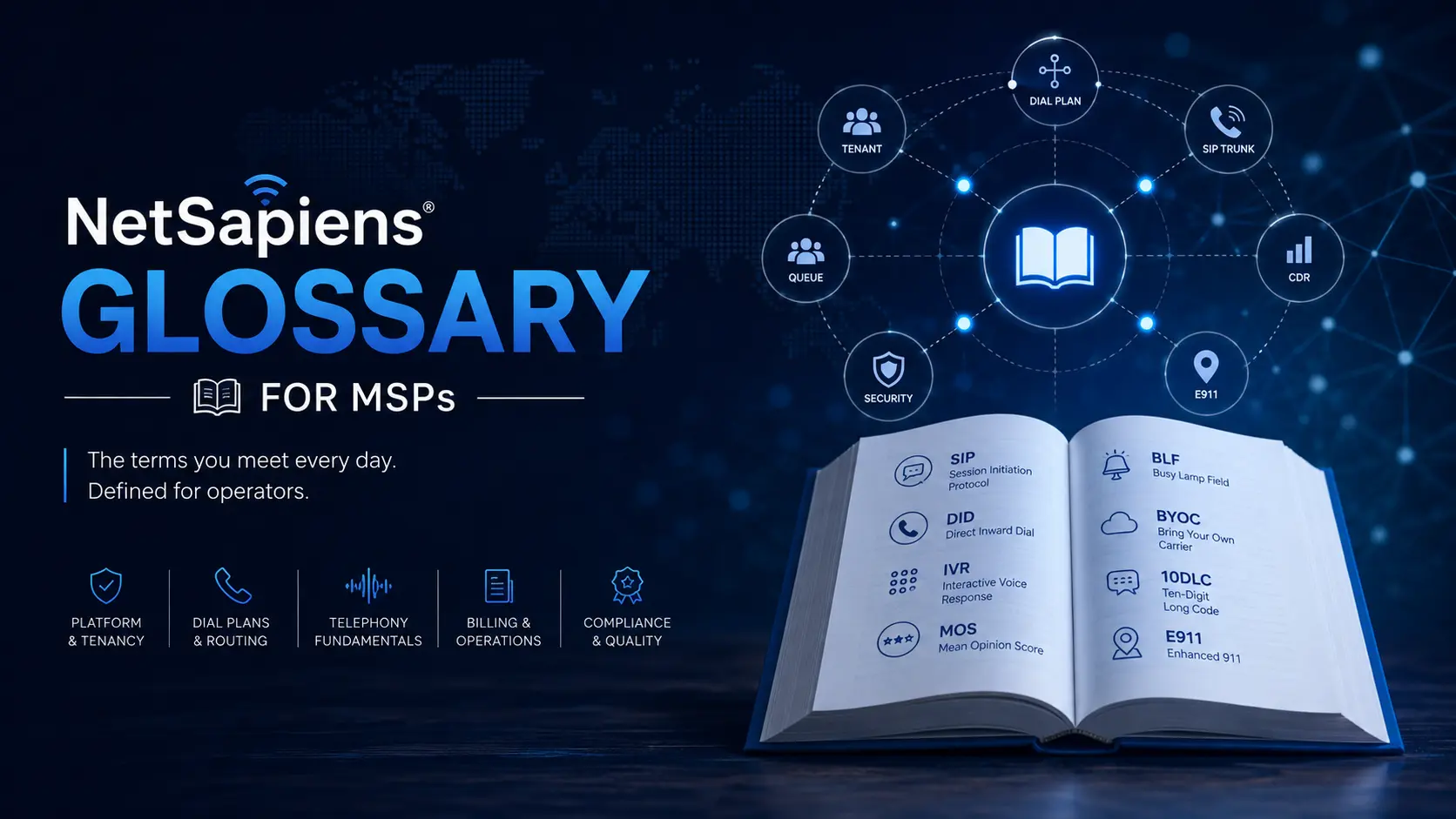
Operating NetSapiens® as an MSP or reseller means living with a mix of platform-specific vocabulary, general telephony jargon, and compliance acronyms. This glossary collects the terms that come up in support tickets, change requests, and customer conversations — defined for operators, not end users.
Skim it once, then anchor-link into individual terms (#dial-plan, #blf, etc.) from your own internal runbooks.
Platform & tenancy
Tenant / Domain {#tenant}
A separate logical customer environment inside a NetSapiens® platform. Each tenant has its own users, devices, dial plans, IVRs, billing, and reports — isolated from every other tenant. NetSapiens® internally uses the term “domain” for what most operators externally call a “tenant.”
Multi-tenant {#multi-tenant}
The platform architecture where a single shared installation hosts many independent tenants in parallel. The opposite of single-tenant, where one installation serves one customer. NetSapiens® is multi-tenant by design; FreePBX is not.
Wholesale UCaaS {#wholesale-ucaas}
A unified-communications-as-a-service platform sold to service providers (rather than to end businesses). The service provider then resells branded phone service to their own customers from that wholesale platform. NetSapiens® is a wholesale UCaaS platform.
Aggregator {#aggregator}
A larger wholesale provider that licenses NetSapiens® from Crexendo and re-sells it down to smaller MSPs and resellers, often with its own value-added platform layer on top. The best-known example is SkySwitch®, a BCM One company.
Bill Center {#bill-center}
The NetSapiens® billing module. Handles rate plans, product catalog, invoice generation, recurring billing, and dispute handling per tenant. Often integrates with QuickBooks or Rev.io for the financial-system side.
Reseller portal {#reseller-portal}
The administrative interface a reseller or MSP uses to operate their tenants — typically a different portal than the end-user softphone or the per-tenant administrator portal. Aggregators (like SkySwitch®) provide their own portals layered over NetSapiens®.
Dial plans & routing
Dial plan {#dial-plan}
The ordered list of match rules attached to a tenant (or higher-level domain) that decides where a dialed call routes. NetSapiens® dial plans are evaluated top-down, first-match-wins. Most routing bugs are precedence bugs.
Match rule {#match-rule}
A single rule inside a dial plan. Has three jobs: match a digit pattern, optionally translate the destination digits, and route the call to a destination. See the dial plan cheat sheet for full anatomy and the seven standard patterns.
Translation rule {#translation}
The part of a match rule that rewrites the destination digits before routing. Common operations: strip a leading access code, prepend a country code, replace with a fixed short-code target.
NANPA {#nanpa}
North American Numbering Plan Administration. The 10-digit phone number format used across the US, Canada, and most Caribbean countries: NXXNXXXXXX where N is 2-9 and X is 0-9. NANPA outbound calls are typically prepended with 1 for E.164 compatibility.
E.164 {#e164}
The international phone-number format: a leading + followed by country code and subscriber number, with a maximum of 15 digits. NetSapiens® carriers typically expect E.164 on outbound trunks for international interop.
IVR {#ivr}
Interactive Voice Response. The auto-attendant menu a caller hears: “Press 1 for sales, 2 for support.” NetSapiens® IVR menus are configured per tenant and can route to queues, users, voicemail boxes, or further IVRs.
Queue / ACD {#queue}
Automatic Call Distribution. The call queue that holds inbound callers until an agent picks up. Configurable in NetSapiens® with priority logic, wait music, overflow rules, and routing strategies (longest-idle, round-robin, etc.).
Hunt group {#hunt-group}
A group of users a call is offered to in sequence (or simultaneously, depending on configuration). Used for small teams that share inbound coverage without needing full ACD.
BLF {#blf}
Busy Lamp Field. The status indicator on a SIP phone showing whether a monitored extension is on a call, ringing, or idle. BLF subscriptions in NetSapiens® use SIP SUBSCRIBE/NOTIFY messaging and are sensitive to firewall and NAT configuration — the BLF presence troubleshooting guide covers the common failure modes.
Presence {#presence}
The general status indicator showing whether a user is available, busy, on a call, or away. Distinct from BLF in that presence can be set manually or driven from softphone activity, not just call state.
Telephony fundamentals
SIP {#sip}
Session Initiation Protocol. The signalling protocol NetSapiens® uses to set up, modify, and tear down calls. Everything you see in a SIP trace — INVITE, 100 Trying, 180 Ringing, 200 OK, ACK, BYE — is SIP signalling.
SIP trunk {#sip-trunk}
The signalling connection between NetSapiens® and a carrier (or between NetSapiens® and an on-premises PBX). Carries call setup, not the audio itself. Audio runs on a separate RTP stream.
RTP / RTCP {#rtp}
Real-time Transport Protocol carries the actual audio packets of a call. RTCP (Control Protocol) carries quality metrics — packet loss, jitter, round-trip-time. If RTCP is enabled in NetSapiens®, the one-way audio troubleshooting guide explains how to read those reports.
SDP {#sdp}
Session Description Protocol. The body inside a SIP INVITE or 200 OK that advertises which IP, which port, and which codecs each side wants the RTP stream on. Most one-way audio bugs are SDP bugs.
Codec {#codec}
The algorithm that encodes audio into RTP packets. Common codecs in NetSapiens®: G.711 (uncompressed, high bandwidth), G.722 (HD audio), G.729 (low bandwidth). Codec negotiation happens in SDP during call setup.
DID {#did}
Direct Inward Dial. A phone number that points to a specific tenant, user, or IVR. Operators provision DIDs from carriers, then route them in NetSapiens® to their destinations.
BYOC {#byoc}
Bring Your Own Carrier. The model where a reseller plugs their preferred SIP trunk provider into NetSapiens® rather than using a NetSapiens®-supplied trunk. Common for cost optimisation or regional coverage.
NAT traversal {#nat-traversal}
The mechanism by which RTP packets find their way between an endpoint behind a firewall and a server on the public internet. NetSapiens® supports several modes including STUN, rport, and media-relay latching. Misconfigured NAT traversal is the most common cause of one-way audio.
SBC {#sbc}
Session Border Controller. The device or software function that sits at the edge of a VoIP network handling SIP and RTP across security boundaries. NetSapiens® platforms typically have an integrated or front-line SBC handling far-end NAT and codec normalisation.
ATA {#ata}
Analog Telephone Adapter. The small box that lets an analog phone or fax machine talk to a SIP-based platform like NetSapiens®. Still common for door entry systems, fax lines, and overhead paging.
Billing & operations
Provisioning {#provisioning}
The process of standing up a new tenant, user, or device — assigning DIDs, configuring features, provisioning IP phones with auto-config files, setting up voicemail boxes. In NetSapiens®, provisioning is per-tenant and benefits heavily from template-and-clone patterns.
Bill Center / Rating engine {#rating}
The billing module that prices each call against a rate plan. NetSapiens® Bill Center handles tenant-level rate plans, product catalogs, and recurring billing. Reconciliation against CDRs is where most billing operations time goes.
CDR {#cdr}
Call Detail Record. The per-call log written for every connection — caller, callee, duration, route, codec, disposition. CDRs feed the billing engine and are the primary forensic source when reconciling disputes.
Reseller / sub-tenant hierarchy {#hierarchy}
NetSapiens® supports nested tenancy: a reseller domain can contain child tenants, each with their own customisations. Useful for aggregators serving sub-resellers, or for an MSP with departmental sub-organisations.
PSA {#psa}
Professional Services Automation. The ticketing and operations platform an MSP uses — ConnectWise, Halo, Autotask, Atera, ServiceNow. White-label support engagements typically integrate directly with the MSP’s PSA so customer-facing ticket history stays in one place.
Compliance
10DLC {#tendlc}
Ten-Digit Long Code. The framework for sending Application-to-Person (A2P) SMS from a regular 10-digit US phone number, governed by The Campaign Registry (TCR). NetSapiens® has native TCR integration for tenants offering SMS.
TCR {#tcr}
The Campaign Registry. The US central authority for 10DLC brand and campaign registration. Operators register their tenants’ brands and SMS campaigns through TCR before traffic can flow at scale. Rejection-prone — the 10DLC vetting guide covers the common failure points.
LNP {#lnp}
Local Number Portability. The process of moving a phone number from one carrier to another. Inbound (port-in) brings a number to your NetSapiens® deployment; outbound (port-out) sends it away. Carrier turnaround and address-mismatch rejections are the two highest-frequency issues.
E911 {#e911}
Enhanced 911. The emergency calling framework that delivers caller location to the public-safety answering point (PSAP). On NetSapiens®, E911 involves registering caller addresses, handling dynamic location updates for mobile clients, and routing 911 calls through compliant carriers. Misconfigured E911 is one of the few VoIP bugs that has legal exposure.
Quality & troubleshooting
MOS {#mos}
Mean Opinion Score. The subjective quality rating of a call, on a 1-5 scale. Most NetSapiens®-friendly NOC tools synthesise MOS from RTCP statistics — packet loss, jitter, and codec — to flag tenants with degraded calls before customers complain.
Jitter {#jitter}
The variation in arrival timing of RTP packets. Steady, predictable arrival is what voice needs. High jitter overwhelms the jitter buffer and produces audible artefacts. Caused by network congestion, asymmetric routing, or under-provisioned uplinks.
SIP ALG {#sip-alg}
Session Initiation Protocol Application Layer Gateway — a feature on consumer-grade firewalls that attempts to fix VoIP NAT traversal and almost always makes it worse. Standard advice for NetSapiens® deployments: disable SIP ALG on every firewall in the path.
Far-end NAT detection {#far-end-nat}
The platform-side feature that detects when an endpoint is behind NAT and rewrites SDP / handles RTP latching accordingly. NetSapiens® has it; enabling it is the single most reliable fix for one-way audio.
Where to go next
For deeper operational coverage of any of these areas, see our NetSapiens® support and operations page. Specific deep-dives live in the blog under their own URLs — most are linked from the relevant glossary entries above.
Independence and disclosure
VoIP Support Pro is an independent provider of support services for the NetSapiens® platform. We are not affiliated with, endorsed by, or sponsored by NetSapiens® or Crexendo, Inc. NetSapiens® is a registered trademark of Crexendo, Inc. Definitions in this glossary describe terms as we use them operationally; the platform’s own documentation remains the canonical source for any version-specific behaviour.