If you operate a phone-service business — as an ITSP, an MSP that resells voice, or a white-label provider behind a larger telecom brand — there’s a strong chance the platform underneath is NetSapiens®, even if your customers never see the name. This guide explains what NetSapiens® actually is, who uses it, and the day-to-day operational realities of running on it.
NetSapiens® in plain English
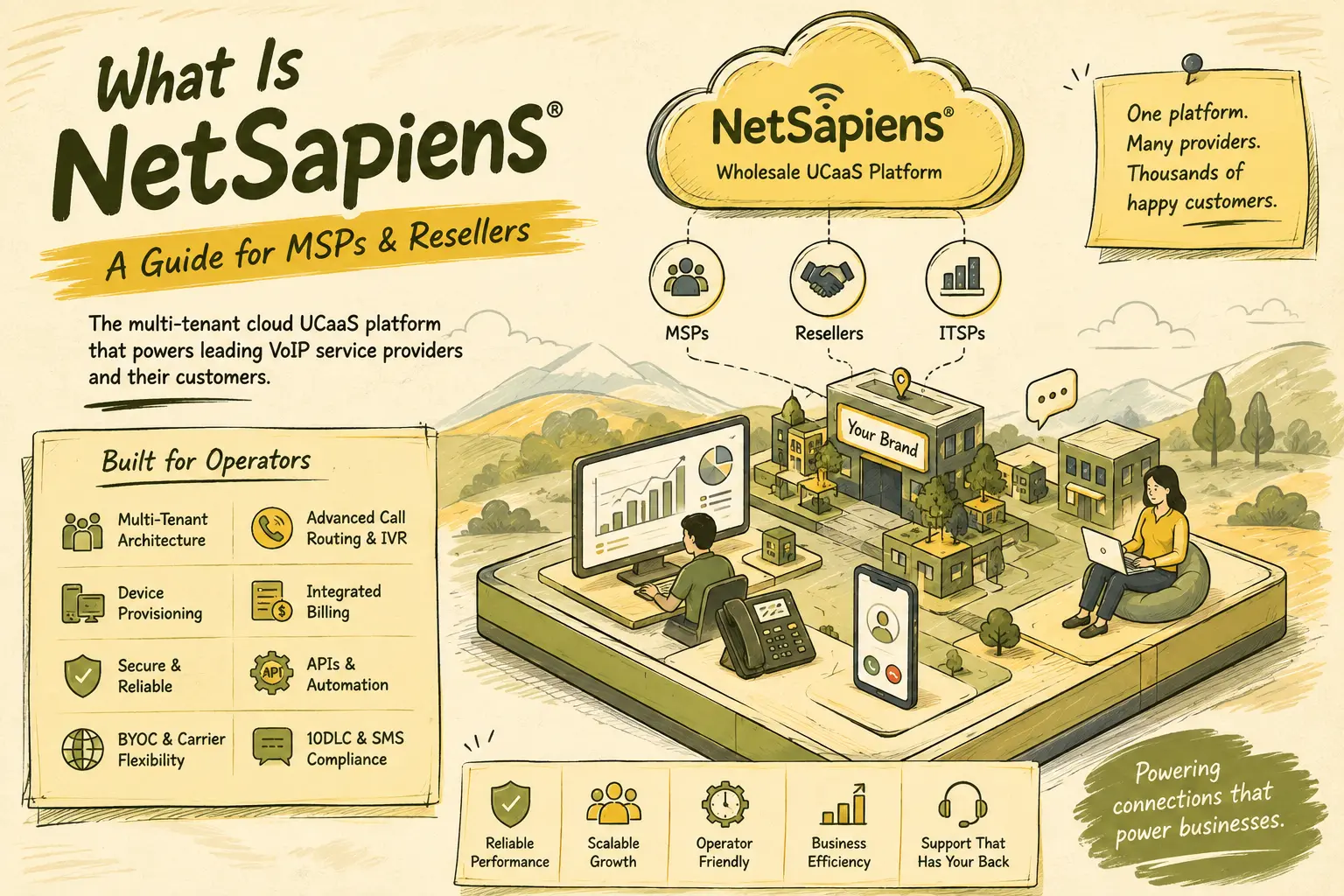
NetSapiens® is a multi-tenant cloud UCaaS (Unified Communications as a Service) platform. In practical terms: it’s the software that lets a service provider sell hosted phone service — dial tone, IVR, call queues, voicemail, mobile and desktop softphones, conferencing — to multiple separate customers from one shared platform, with each customer isolated inside their own tenant.
It’s not a phone system you buy and install in your office. It’s the wholesale platform that the company selling you a phone system runs in their data centre to deliver the service. End businesses see their service provider’s branding; the NetSapiens® name typically lives behind the scenes.
NetSapiens®, Inc. was acquired by Crexendo, Inc. in 2021. Crexendo (NASDAQ: CXDO) now operates NetSapiens® as the wholesale platform behind a substantial share of independent VoIP service providers in North America and, increasingly, internationally.
Who actually runs on NetSapiens®
The platform is built for operators, not end users. The four operator types we see most often:
- Independent ITSPs and CLECs. Regional carriers running their own brand, often with their own interconnect and DID inventory, operating dozens to hundreds of tenants.
- MSPs that bundle voice with IT. Managed service providers who sell phone service alongside helpdesk, networking, and managed compute. Voice is one line item inside a larger MSP relationship.
- White-label resellers. Companies whose business is hosted phone service. Operationally similar to an ITSP, but typically not running their own carrier infrastructure — they source trunks from a wholesale provider instead.
- Larger UCaaS aggregators. Wholesale providers that themselves resell NetSapiens® to smaller MSPs and resellers. SkySwitch® (a BCM One company) is the best-known example in this category — many MSPs run on NetSapiens® via SkySwitch® without licensing the platform from Crexendo directly.
If you’re an end business choosing a phone provider, you’ll see their brand. If you ask what their platform is and they say “NetSapiens®,” it tells you the engineering layer underneath is shared with a wide cohort of operators — which has implications for support quality, customisation, and longevity that are worth knowing.
Core capabilities at a glance
NetSapiens® is feature-broad. What an operator typically uses on a daily basis:
- Multi-tenant cloud PBX. Each customer is a separate tenant (a “domain” in NetSapiens® vocabulary), isolated from every other tenant on the platform. Users, devices, extensions, queues, voicemail boxes all live inside the tenant.
- Dial plans and call routing. The platform’s dial-plan engine handles incoming and outgoing number translation, time-of-day routing, IVR menus, call queues, hunt groups, and feature-code dialling.
- Provisioning for IP endpoints. Auto-provisioning for the common business desk phone brands (Yealink, Poly, Cisco) plus mobile and desktop softphone apps.
- Billing platform integration. Per-tenant rating, invoice generation, recurring billing workflows. Many operators pair NetSapiens® with QuickBooks, Rev.io, or a custom rating engine for the financial side.
- REST and SOAP APIs. Most platform actions can be automated, which matters for resellers running self-service portals or syncing tenant data into their PSA.
- Carrier and BYOC support. SIP trunks from major wholesale carriers are supported; many operators run BYOC (Bring Your Own Carrier) for cost or coverage reasons.
- 10DLC compliance hooks. For SMS-enabled tenants, the platform supports the brand and campaign registration workflow required by The Campaign Registry (TCR) for US Application-to-Person messaging.
This is not the full feature set — it’s the surface area an MSP or reseller actually deals with operationally. The deeper internals (carrier media gateways, RTP relay, media transcoding, recording archive) generally live below the line of normal support work and only surface during incident response.
Common operational challenges
This is the part most “what is” guides skip. NetSapiens® is operationally rich, which means it’s also operationally easy to break. Patterns we see daily across multiple operators:
- Dial plan complexity. Match rules misorder, a NANPA translation overrides an intentional E.164 routing, time-of-day conditions don’t unwind correctly between holidays and shoulder hours, presence rules conflict with hunt-group failover.
- Multi-tenant configuration drift. Operators build templates for new tenants, then a year of one-off customer requests turns each tenant into its own snowflake. Auditing what’s actually configured per tenant becomes the painful part.
- Billing operations. Rate plan changes, prorated cutovers, dispute handling, recurring billing reconciliation against CDRs — tedious, unforgiving, and the platform doesn’t catch operator mistakes.
- Number porting (LNP). Inbound ports rejected for trivial reasons (address mismatch, wrong losing carrier identified), porting-day timing, and ENUM/E911 propagation after the port lands.
- 10DLC compliance. Brand registration, campaign vetting, throughput allocation, ongoing compliance monitoring — all rejection-prone, all material to the tenant if it goes wrong.
None of these are exotic; all of them eat engineering hours that could be going into customer growth instead.
That’s why many MSPs and resellers run with an outsourced support layer beneath their own brand — to absorb the day-to-day operational work without growing their own engineering headcount linearly with customer count. If that model fits your business, our NetSapiens® support and operations page explains how we structure white-label Tier 1–4 support on the platform.
Independence and disclosure
We say this in our footer and we’ll say it here too: VoIP Support Pro is an independent provider of support services for the NetSapiens® platform. We are not affiliated with, endorsed by, or sponsored by NetSapiens® or Crexendo, Inc. NetSapiens® is a registered trademark of Crexendo, Inc., and we use the name only as required to describe the platform we operate on.
If you’re scoping out which UCaaS platform fits your business, or deciding whether to start your own VoIP service on NetSapiens®, talk to Crexendo directly. If you’re already running on NetSapiens® and need help with the operational side — dial plans, provisioning, billing, porting, 24/7 coverage — that’s where we fit, and we’re happy to scope what makes sense.