
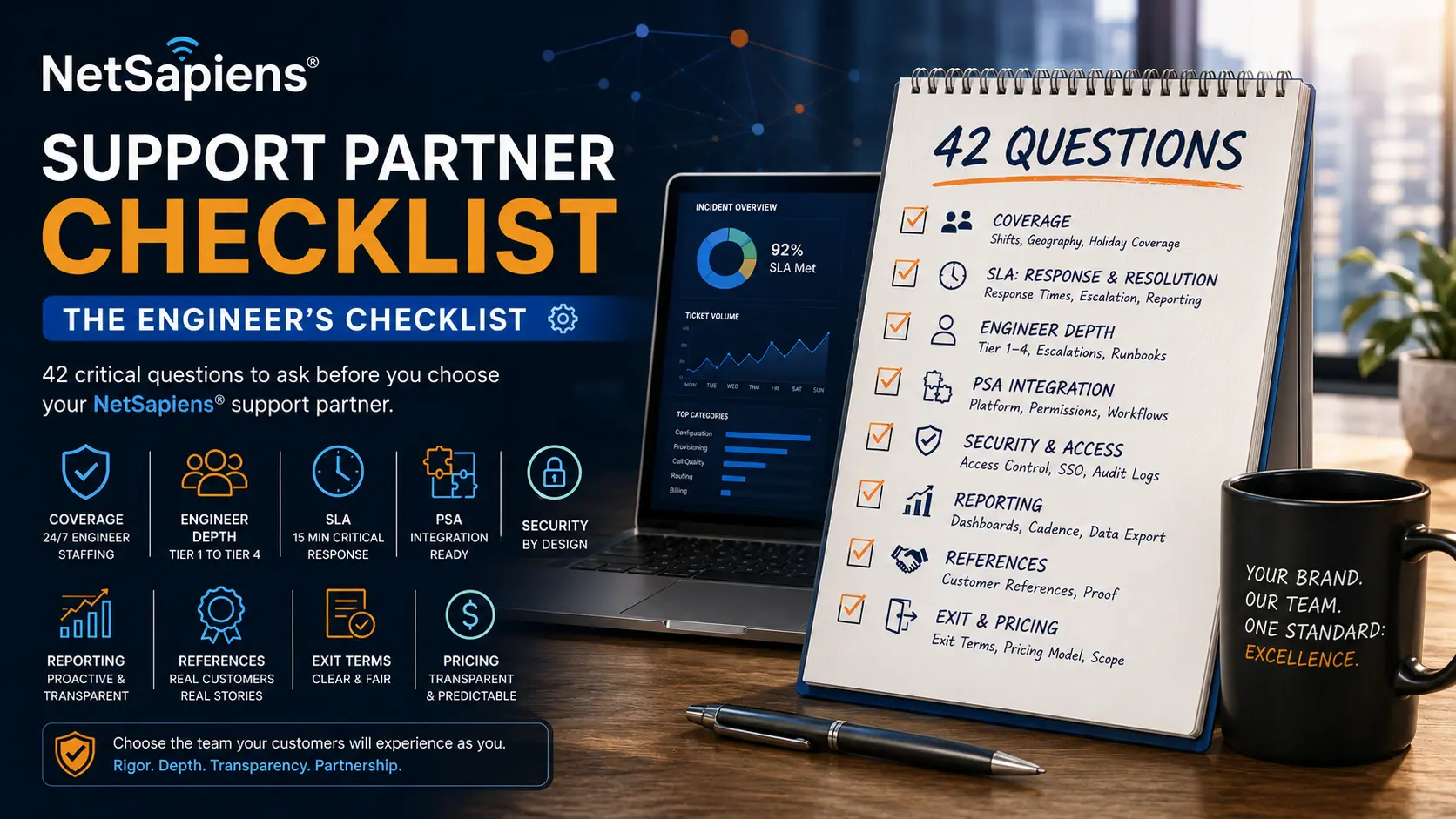
Vendor selection for VoIP support is usually run as a feature comparison. That misses the point. You’re not picking software — you’re picking the team your customers will quietly experience as you. The partner that looks best in a sales demo isn’t necessarily the partner that survives the third 3am incident. This is the engineer’s checklist: 42 questions across coverage, escalation, PSA integration, security, exit terms, references, and operational proof. It’s the version you want to use, not the marketing version.
Coverage
Shift staffing, not just “24/7”
- What hours are engineers actually on shift in each region (not on call)?
- What’s the shift handover protocol? Who reviews open tickets at shift change?
- Are weekend engineers the same tier composition as weekday engineers?
- What’s the holiday coverage policy? Are major holidays covered at the same staffing level?
- How many engineers are on shift at the lowest-staffed hour of the week?
Geography
- Where are the engineers physically located (regions, time zones)?
- Is there a single team or multiple regional teams?
- If there are multiple regions, what’s the handoff protocol between them?
SLA: response and resolution
Response
- What’s the response SLA on a critical incident? What is “critical” defined as?
- What’s the response SLA on a high-priority but non-critical incident?
- Are responses measured to first substantive engineer reply or just acknowledgment?
- Show me a quarter of actual response-time data, anonymized.
Resolution
- Do you commit to resolution SLAs, or only response SLAs?
- What’s the progress-reporting SLA during a Sev-1 incident?
- What’s the formal escalation path if a Sev-1 isn’t resolved within the target window?
Engineer depth: Tier 1 through Tier 4
- How many Tier 4 NetSapiens® engineers do you have on staff?
- What percentage of tickets are resolved at each tier?
- What is the Tier 1 → Tier 2 escalation threshold? Time-based, complexity-based, or named-category-based?
- Who owns the customer-facing conversation when a ticket escalates from Tier 1 to Tier 3?
- Show me a redacted runbook for a complex incident — pcap analysis, codec negotiation issue, or carrier coordination.
PSA integration
- Which PSAs do you currently work inside?
- Do you require your own PSA or work inside ours?
- Who pays for the PSA seat licenses for your engineers?
- How do you handle PSA permissions — full ticket access, restricted by tenant, restricted by customer?
- What’s the procedure when our PSA has an outage and tickets can’t be created normally?
Operational scope
- What’s included in the base engagement?
- What is explicitly out of scope (e.g., hardware procurement, on-site dispatch, customer-facing sales)?
- How are out-of-scope requests handled — refusal, separate scoping, time-and-materials?
- What’s the change-management protocol for dial-plan or platform-side changes?
- How are changes logged and made auditable?
Security and access
- What access do your engineers need to NetSapiens® tenants? Full admin, scoped read-write, or read-only with change requests routed through us?
- Do you support SSO with our identity provider for engineer access?
- What’s the access offboarding procedure when an engineer leaves your team?
- Is engineer activity logged and available for our audit?
- What is your incident-response procedure for a security event on your side?
Reporting
- What reports do we receive without asking?
- What is the reporting cadence (weekly, monthly, quarterly)?
- Show me a sample monthly operations report from a customer of similar size.
- Can we get raw ticket data exported for our own analysis?
References
- Provide two references from customers of similar size to ours. Speak with them directly, without you on the call.
Exit and pricing
- What’s the exit clause? Notice period, fees, data handover procedure?
- What’s the pricing model? Per-seat, per-tenant, per-ticket, retainer, tiered package? What’s specifically excluded from the lower tiers?
How to evaluate the answers
The answers individually matter less than the patterns across them. Watch for:
Specificity vs vagueness
A partner that answers shift staffing with “we have 24/7 coverage” is signaling either a sales focus or an under-defined operation. A partner that answers “we have 2 engineers on shift weekdays 9-5 ET, 1 engineer on shift overnight, weekend coverage is 1 Tier-2 + on-call Tier-3” knows their operation.
Written commitments vs verbal assertions
Most claims that matter should appear in the contract. SLA percentages and credits, exit terms, response time definitions, escalation thresholds — all written. If a partner declines to commit something in writing that they said verbally, that’s data.
Reference quality
References from satisfied customers should sound like engineers describing operational reality, not like marketing testimonials. The right reference describes a specific incident the partner handled well, a process detail that matters to them, or a friction point that the partner navigated. Generic “they’re great to work with” is signal — usually negative signal.
Boundary clarity
A partner that won’t draw clear in-scope / out-of-scope lines is either over-promising or under-thinking. Boundaries protect both sides; ambiguity around boundaries leads to disputes during incidents.
Reporting initiative
If you have to ask for the monthly report, it’s not really a real artifact. The reporting cadence question reveals whether reporting is an operational discipline or a sales claim.
What separates the partners worth working with
After 42 questions, the difference between top-tier and middle-tier partners is usually clear on three dimensions:
- Operational rigor: do they run their work as a documented engineering function (runbooks, change logs, post-incident reviews) or as ad-hoc fire-fighting?
- Bench depth: do they have actual Tier 4 engineers in number, or is the senior tier one or two people who become single points of failure?
- Customer fit: have they worked with companies of your specific shape — your customer size, your platform, your operational tempo — or are they generalists?
The best partners answer the 42 questions with precision and produce written commitments. The worst answer with marketing language and want to schedule another call.
A note on pricing
Pricing should be the last conversation. Cheap-and-bad costs more than expensive-and-good — when a partner can’t deliver, the customer impact is yours to absorb. The right framing: what coverage and operational quality do we need, and what’s the lowest cost to get that, not what’s the lowest cost partner that claims to do this work.
For most MSPs and resellers running NetSapiens®, the answer to “what coverage and quality do we need” includes 24/7 Tier 1-4 staffing, PSA integration, documented runbooks, and a 15-minute critical SLA. Our white-label VoIP helpdesk service is designed around exactly this profile, and our outsourced VoIP billing support service covers the operational layer that ticket support sits alongside — invoice runs, rating, disputes, carrier reconciliation.
The questions you don’t ask explicitly
Two final signals that come from the conversation itself, not from any specific answer:
- Do they ask you questions back? A partner that wants to understand your operation before pricing it is signaling operational discipline. A partner that quotes immediately is signaling they treat all customers the same — which means they’re not adapting to your needs.
- What do they tell you no about? A partner that says yes to everything is either lying or hasn’t thought through the boundary. A partner that explains “we don’t do X — here’s why, here’s what we recommend instead” is signaling honest assessment of fit.
After 42 questions and these two signals, you usually know which partner to pick. The decision is harder when partners look similar on paper but feel different in conversation — trust the conversation. The team that’s going to support your customers for the next five years is the team you can stay in honest dialogue with through hard incidents.