
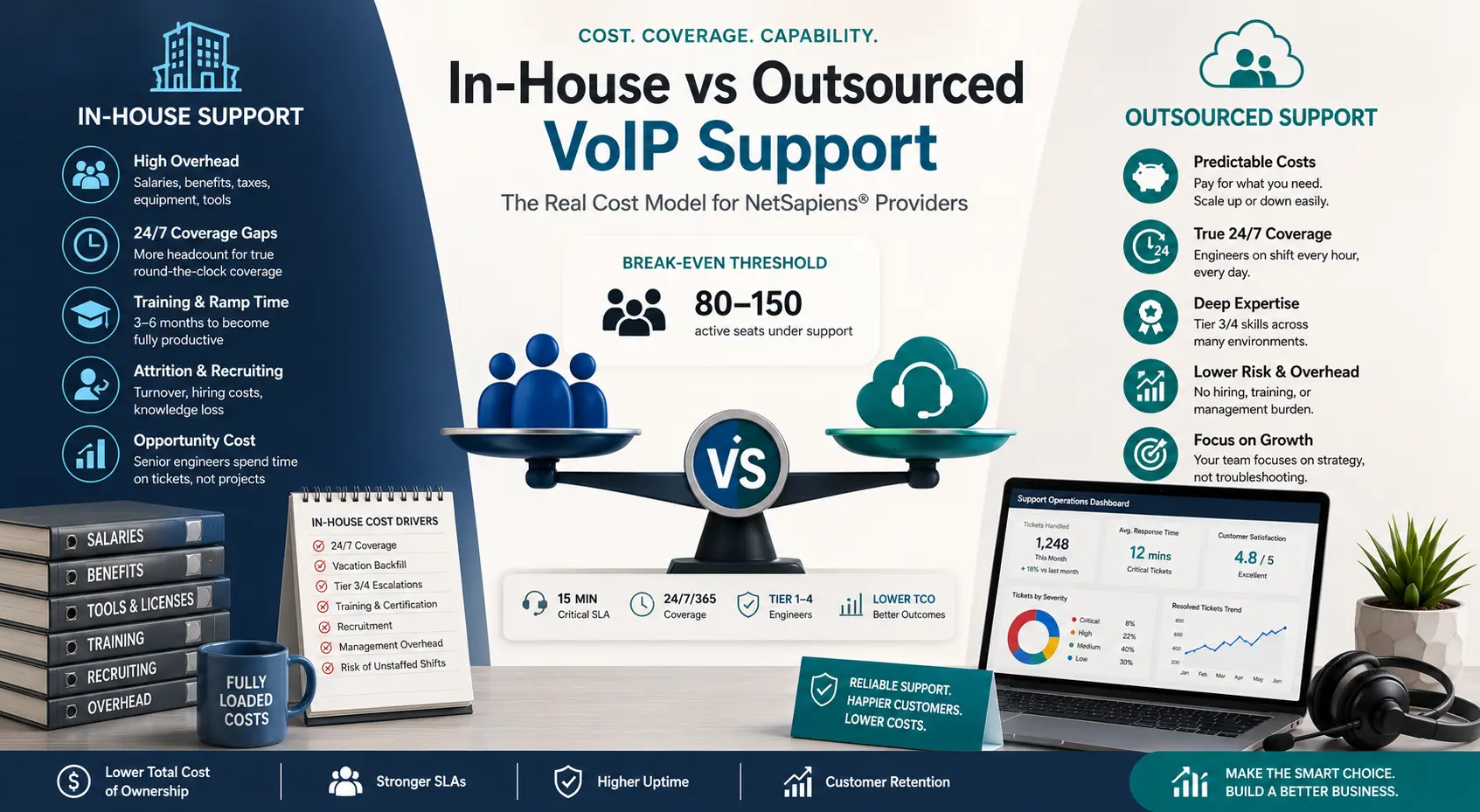
The “in-house vs outsourced” comparison for VoIP support is usually framed as fully-loaded salary against monthly retainer. That math is wrong in both directions — it overstates outsourced cost for low-volume providers and understates in-house cost for everyone. This is a defensible cost model that includes the hidden costs (coverage gaps, escalation depth, attrition, training overhead, opportunity cost), and the headcount thresholds where the equation actually flips. The goal is a model you can plug your own numbers into, not a vendor pitch.
The variables that actually matter
A complete cost model includes:
- Direct labor cost: salary + benefits + payroll taxes.
- Coverage cost: number of engineers needed to maintain stated coverage hours.
- Escalation depth cost: cost of having Tier 3/4 engineers available, especially during nights and weekends.
- Recruiting and training cost: cost of hiring, onboarding, and bringing each engineer to productive output.
- Attrition cost: cost of replacing engineers when they leave.
- Operational overhead: management, tooling, runbook maintenance, PSA licenses.
- Opportunity cost: what your existing team isn’t doing while they’re answering tickets.
- Risk cost: the cost of an unstaffed shift, a missed SLA, a customer-impacting incident.
Most calculators include the first two and skip the rest. The skipped items are usually 30-60 % of the real cost.
Direct labor cost
Salary numbers vary by region. For US-based VoIP engineers in 2026, conservative ranges:
- Tier 1: $50,000 - $65,000 base.
- Tier 2: $70,000 - $90,000.
- Tier 3: $95,000 - $130,000.
- Tier 4 (platform engineer): $130,000 - $180,000.
Multiply by 1.3 to 1.4 for fully-loaded cost (benefits, taxes, equipment, software). A Tier 2 engineer at $80,000 salary costs ~$108,000 fully loaded.
Coverage cost — the variable most calculators get wrong
If you advertise 24/7/365 coverage with a 15-minute response SLA, you need engineers actually on shift every hour. The math:
- 24 hours/day × 365 days/year = 8,760 hours of coverage needed.
- One engineer working full-time covers ~2,000 hours/year (40 hours × 50 weeks accounting for vacation, training, sick time).
- Minimum 4.4 engineers for one-engineer-on-shift coverage.
- Realistically, you need 5-6 engineers to allow shift overlap, sickness, vacation, and ramp time.
At Tier 2 fully-loaded ($108K), that’s $540,000 - $648,000/year for one continuous Tier 2 seat. Tier 1 alone won’t cut it for after-hours coverage because the harder incidents disproportionately happen outside business hours (this is well-documented in MSP operations data).
To staff a real 24/7 Tier 2 + Tier 3 + on-call Tier 4 model:
- 5-6 Tier 2 engineers: $540K - $648K
- 2-3 Tier 3 engineers (covering escalations across shifts): $200K - $390K
- 1 Tier 4 on-call (10-20 % of an engineer’s time): $13K - $36K
- Total: $753K - $1,074K per year for a meaningful coverage model.
This is the number most in-house cost comparisons skip. They calculate “we’ll hire 2 engineers” — but 2 engineers cannot deliver 24/7 coverage at any quality level, period.
Recruiting and training cost
For specialist VoIP engineers (NetSapiens®, SIP, dial plans):
- Recruiting cost per hire: $5,000 - $15,000 (recruiter fees, time, candidate interviews). NetSapiens® specialists are rare; expect the higher end.
- Time to productive output: 3-6 months. During this time, the engineer’s contribution is net-negative (they consume mentor time).
- Training overhead: 100-200 hours per new hire of senior-engineer time. At Tier 3 fully-loaded ($150K = $75/hour), that’s $7,500 - $15,000 of mentor time per new hire.
Annual amortized recruiting + training cost per seat: $5,000 - $10,000 for stable headcount, much higher during growth.
Attrition cost
US tech turnover runs 13-19 % annually. Telecom-specialist turnover tends toward the higher end because the skill is portable and demand exceeds supply.
For a 6-engineer in-house team at 15 % attrition, you’re replacing about one engineer per year — full cost (recruiting + training + ramp + productive-output gap during transition): $50,000 - $100,000 per replacement.
Operational overhead
Often overlooked:
- PSA license per seat: $500 - $2,000/year per seat depending on platform.
- Management overhead: a team of 6-10 needs a team lead at $130K+; that’s roughly $15K-$20K of cost per engineer when you allocate.
- Tooling: ticketing system, monitoring, voice analytics tools — $5K - $20K/year per seat.
- Runbook maintenance and training: ongoing engineering time, 5-10 % of senior engineer hours.
Opportunity cost — the often-invisible line
When your existing senior engineers spend 30 % of their time on Tier 1-2 tickets they shouldn’t be touching, they’re not building new automation, migrating customers onto your platform, or improving operational margin. The opportunity cost is the value of what they would have done instead.
For a senior engineer at $150K fully-loaded, 30 % of their time is $45K/year of opportunity cost — and the opportunity-cost value is often higher than the direct labor cost they’re displacing, because it’s the high-leverage work that scales the business.
Risk cost
A single multi-customer outage caused by an unstaffed shift can cost more than a year of outsourced support:
- Direct revenue refund: SLA credits, often 10-100 % of monthly recurring for affected customers.
- Customer churn: a customer that experiences a multi-hour outage during business hours has a 30-50 % chance of evaluating alternatives within 60 days.
- Reputational cost: harder to quantify, but cumulative across customers.
A single $100K - $500K incident every 2-3 years from coverage gaps amortizes to $30K - $250K of annualized risk cost.
Outsourced support cost structure
Real outsourced support pricing for NetSapiens®-specialized providers in 2026:
- Per-seat (low end): $20 - $40 per seat per month.
- Per-tenant retainer: $1,500 - $5,000 per month per managed tenant.
- Tiered packages: $3,000 - $15,000 per month covering a defined customer base.
For a reseller with 20 customers averaging 50 seats each (1,000 total seats):
- Low-end per-seat: $20K - $40K per month = $240K - $480K per year.
- Tiered package: typically $5K - $15K per month = $60K - $180K per year.
The wide range reflects scope differences. The high end is closer to fully-managed (helpdesk + escalation + platform engineering + billing + NOC). The low end is helpdesk-only.
The threshold where in-house actually makes sense
The break-even point isn’t a fixed customer count — it’s the intersection of three thresholds:
- Ticket volume: above ~500 monthly tickets, you have enough work to keep 4-6 engineers productively occupied.
- Coverage requirement: if you can accept “best effort overnight” instead of 15-minute SLAs, you don’t need the 24/7 staffing model, and in-house cost drops dramatically.
- Tier 4 demand: if you have <2 Tier 4 escalations per month, you don’t need a Tier 4 engineer on staff; you can buy that depth as-needed.
Below those thresholds, outsourced wins on direct cost alone. Above them, the math gets closer — but the in-house number rarely beats outsourced by more than 20 %, and it loses on every non-cost dimension (coverage continuity, attrition resilience, escalation depth, ramp time).
A worked example
Reseller with 25 customers (1,250 total seats), 250 monthly tickets, requires 24/7 coverage with 15-minute SLA:
In-house option:
- 5 Tier 2 engineers: $540K
- 2 Tier 3 engineers: $260K
- 1 part-time Tier 4: $30K
- Overhead, recruiting, attrition, opportunity cost: $120K
- Total: ~$950K/year
Outsourced option (mid-tier package):
- $8K/month: $96K
- Total: ~$96K/year
Difference: nearly 10x. Even after factoring in your remaining internal overhead, customer-facing communication, and partner management time, the outsourced number is 1/5 to 1/3 of the in-house number for the same coverage and SLA quality.
When in-house wins
Three scenarios:
- Very small operations (< 5 customers, ticket volume measured in dozens/month) where you don’t need 24/7 coverage. A single in-house engineer handles the load.
- Very large operations (>100 customers, dedicated VoIP business unit) where you can fully staff specialized teams and the economies of scale work in-house.
- Strategic differentiation: if your VoIP support quality is a core differentiator and you’ve decided in-house is the only way to control that, the cost differential is acceptable.
For everyone in the middle — and that’s most MSPs and resellers — outsourced is more economical, more resilient, and faster to scale.
How to decide
Run the model for your own numbers. The honest decision criteria:
- Can you afford the staffing cost for genuine 24/7 SLA quality?
- Can you tolerate the attrition cycle without coverage gaps?
- Is VoIP support a differentiator you want to own, or operational overhead you’d rather outsource?
If the answer to all three is yes, build in-house. If any of them is no, our white-label NetSapiens® helpdesk service is built specifically for this scenario — 24/7/365 engineer coverage with 15-minute critical SLA, operating under your brand inside your PSA. For providers considering an outsourced operations layer that also covers migrations and platform consolidation, our VoIP migration service handles the cutover work that often coincides with the outsourcing decision.
The math will tell you which side of the line you’re on. The non-cost factors — resilience, depth, ramp time, opportunity cost — usually tell you the same thing more decisively than the spreadsheet does.